


A trusted knitwear manufacturer
A trusted knitwear manufacturer empowering your brand expansion.
Start your brandjourney today.

Wed 08 , 2026
Developing custom women's clothing requires more than a good design concept. For fashion brands, retailers, wholesalers, and private label businesses, the technical development stage determines whether a garment can be produced consistently, meet the intended fit, and maintain quality during bulk manufacturing.
A design may look straightforward on a sketch, but factors such as fabric behavior, pattern construction, sizing, seam engineering, shrinkage, and trim selection can significantly affect the finished product. For this reason, brands should establish clear technical requirements before moving from an initial concept to mass production.
An experienced custom women's clothing manufacturer can help brands evaluate these factors during sampling and product development. Sharon Garment provides custom design development, pattern making, custom fabric options, and OEM/ODM apparel manufacturing, supporting brands from initial concepts through production.
Fabric is one of the first technical factors that should be confirmed during custom garment development. Fiber composition, fabric weight, structure, stretch, recovery, and finishing can all influence the final appearance and performance of a garment.
For example, a lightweight woven fabric may be appropriate for a blouse, while a stretch knitted fabric may be more suitable for a fitted tank top. Cotton, polyester, rayon, nylon, and blended fabrics can also behave differently during cutting, sewing, washing, and finishing.
Before approving a fabric, brands should consider fiber composition, GSM, fabric width, stretch percentage, stretch recovery, shrinkage, colorfastness, pilling resistance, and washing performance.
For brands developing custom women's T-shirts or Tank Tops And Vests, fabric selection should be evaluated together with the intended fit and construction method.
Sharon Garment states that it operates its own fabric mill and has fabric development and procurement capabilities, providing a stable supply of greige fabric for garment development.
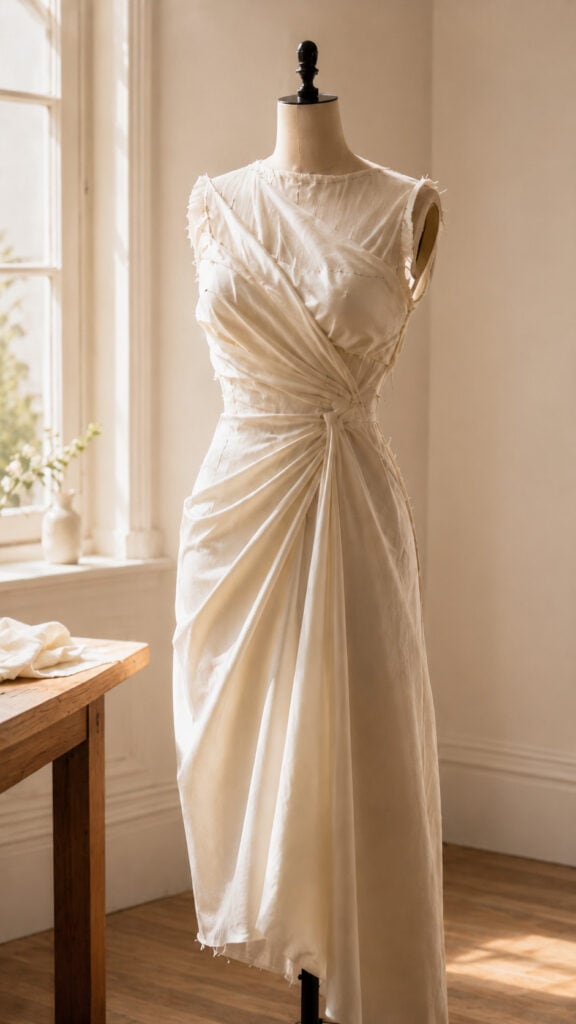
Pattern development transforms a design concept into a production-ready garment. It determines how the garment fits the body and how individual panels are shaped and assembled.
Women's clothing requires particular attention to bust, waist, hip, shoulder, armhole, neckline, and garment length measurements. The same design can produce significantly different results when the pattern or ease allowance changes.
Brands should clearly define whether the intended garment is slim fit, regular fit, relaxed fit, or oversized. The pattern should then be developed according to the target customer, fabric characteristics, and construction requirements.
For example, a custom women's blouse may require careful control of collar dimensions, sleeve construction, shoulder width, and body ease, while a fitted tank top may require greater attention to armhole shape and stretch recovery.
Sharon Garment offers pattern making based on drawings and sample replication, as well as original design development and custom styles. Its website states that it has a dedicated design and pattern-making team supporting these processes.
A garment that fits correctly in one size still needs to be engineered properly across the full size range.
Once the base size has been approved, the pattern must be graded according to the brand's size specifications. Grading should consider how bust, waist, hip, shoulder, sleeve, and garment length measurements change between sizes.
Measurement tolerances should also be established before bulk production. Without clear tolerances, suppliers and buyers may have different interpretations of what constitutes an acceptable production variation.
This is particularly important for fitted garments and bottomwear. For example, women's trousers and women's shorts require careful control of waist, hip, rise, inseam, and leg measurements to achieve consistent fit.
Garment construction affects durability, comfort, appearance, and production efficiency.
Different garment categories require different sewing and seam construction methods. A lightweight blouse may require fine seam finishing, while a sweatshirt or hoodie made from heavier fabric requires construction methods suitable for greater material thickness.
Technical specifications may include seam type, seam allowance, stitch type, stitch density, thread specification, needle selection, reinforcement points, hem construction, and topstitching.
For example, the neckline and shoulder seams of a T-shirt need to maintain stability after repeated washing, while the construction of a women's sweatshirt or hoodie must account for heavier knitted fabrics.
The goal is not simply to make the first sample look correct. The construction must also be suitable for repeatable bulk manufacturing.
Stretch performance is an important consideration for fitted women's clothing.
A fabric may provide sufficient initial stretch but still have poor recovery. After repeated wear, the garment may lose its original shape or become less supportive.
Brands should evaluate horizontal stretch, vertical stretch, stretch recovery, fabric growth, seam elasticity, shape retention, and dimensional stability.
The relationship between fabric stretch and pattern ease should also be considered. A pattern developed for a non-stretch fabric cannot necessarily be transferred directly to a stretch fabric without adjustment.
This is particularly relevant when developing fitted tops, tank tops, and other garments where comfort and body fit are important.
Color consistency should be controlled throughout product development and bulk manufacturing.
A color selected from a digital image may appear differently depending on the fabric composition, dyeing process, lighting conditions, and finishing treatment. For this reason, professional garment development normally requires a defined color approval process.
Brands should establish color references, lab dip requirements, shade tolerances, colorfastness expectations, and production lot controls.
Color consistency becomes even more important when several garments are designed as part of the same collection. For example, a coordinated collection containing women's co-ords, skirts, tops, and dresses may require multiple fabrics or garment types to maintain a consistent visual color standard.
The main fabric is only one part of a finished garment. Buttons, zippers, elastic, labels, drawcords, snaps, embroidery, prints, and other components can influence the garment's appearance and performance.
Each component should be clearly specified in terms of material, size, color, finish, placement, and performance requirements.
Compatibility is also important. A zipper needs to be suitable for the fabric weight and garment structure, while elastic needs to provide appropriate recovery without creating excessive pressure.
For private label clothing, branding components should also be considered during the technical development stage. Labels, hangtags, packaging, and other customized elements should be confirmed before bulk manufacturing.
Shrinkage can affect garment dimensions after production and washing. The actual change depends on fiber composition, fabric structure, dyeing, finishing, and washing conditions.
Before bulk production, brands should evaluate potential changes in garment length and width as well as twisting, color change, seam puckering, surface appearance, and shape deformation.
Testing the actual production fabric is more reliable than assuming that all fabrics with the same fiber composition will behave identically.
For everyday products such as women's dresses, T-shirts, blouses, and trousers, washing performance is particularly important because the garment needs to maintain acceptable dimensions and appearance throughout normal use.
A detailed tech pack creates a technical reference between the brand and the manufacturer.
A complete specification can include technical sketches, measurement charts, bill of materials, fabric composition, fabric weight, color references, trim specifications, construction details, label placement, packaging requirements, measurement tolerances, and revision records.
Clear documentation reduces the possibility of misunderstandings during sampling and production.
For brands developing several products simultaneously, standardized specifications can make communication more efficient. A collection may include women's blouses and shirts, T-shirts, skirts, dresses, trousers, and co-ords, with each product requiring its own technical specifications.
The more clearly these requirements are documented, the easier it becomes to evaluate samples and maintain consistency during bulk production.
The pre-production sample should be treated as the technical reference for mass production.
Before approving bulk manufacturing, brands should review the garment's overall fit, measurements, fabric, color, seam construction, stitch quality, trim placement, labels, washing performance, packaging, and final appearance.
Any changes made during sample approval should be recorded and incorporated into the final production specifications.
During bulk production, quality control should compare finished garments against the approved sample and technical specifications. This provides a more objective method of identifying production deviations.
Sharon Garment states that its production, post-production inspection, and QC teams work together to maintain consistent garment quality. The company also operates production facilities in multiple locations and maintains in-house secondary processing capabilities including digital printing, white ink heat transfer, and embroidery.
Custom women's clothing development is a process that connects design, fabric selection, pattern engineering, garment construction, sampling, quality control, and mass production.
The technical decisions made before bulk manufacturing can directly affect product quality, production efficiency, cost control, and customer satisfaction. A well-developed garment should not only look correct in a sample but also be technically suitable for repeatable production.
Whether a brand is developing a basic women's T-shirt, a fitted tank top, a structured women's blouse, a seasonal dress, or a complete women's co-ord collection, technical requirements should be defined before mass production begins.
With custom design development, pattern making, fabric development, OEM/ODM capabilities, and integrated manufacturing, Sharon Garment provides brands with a complete approach to custom women's apparel development.
We attach great importance to the customers' demands for product quality and rapid production.
We always believe that meeting the customers' needs is the realization of our value!

Tel:+61 414 284 868
E-mail: sharon.apparelco@gmail.com
Address:Room 101, No. 49, Chonghuan East Road, Shijie Town, Dongguan City, Guangdong Province
Copyright © 2026 Dongguan Sharon Garment Co., Ltd. All rights reserved.
Privacy Policy / Cookie Policy / Terms & Conditions