


A trusted knitwear manufacturer
A trusted knitwear manufacturer empowering your brand expansion.
Start your brandjourney today.

Wed 09 , 2026

Most custom clothing orders take 45 to 90 days from tech pack approval to goods leaving the factory, and the single biggest mistake fashion brands make is working backwards from a launch date that was never realistic to begin with. Lead time is not one number. It is the sum of sampling, fabric sourcing, bulk production, and final inspection, and every one of those stages runs on its own clock. This guide breaks down how long each stage actually takes for custom knitwear, what quietly pushes the schedule longer, and how to build a production timeline you can genuinely hit.
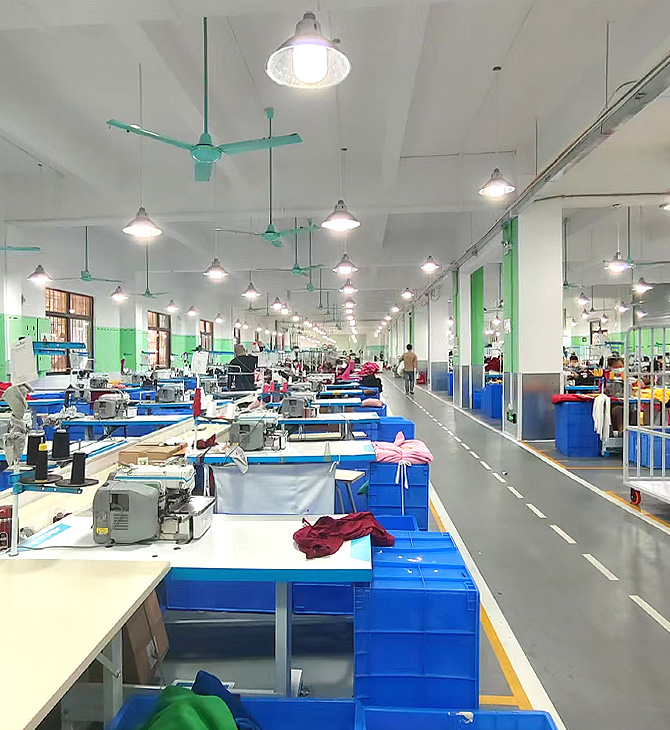
Custom clothing manufacturing lead time is the total elapsed time between two fixed points: the moment your order is confirmed and your tech pack is approved, and the moment finished garments are packed and ready to leave the factory. Anything that happens before approval — your own design work, market research, choosing a fabric direction — sits outside the lead time, which is why two brands ordering the same style can report completely different schedules.
apparel manufacturing lead time is normally quoted in working days rather than calendar days, which matters as soon as factory holidays enter the picture. It also helps to separate lead time from transit time. Lead time ends at the factory gate. Ocean freight to Europe or the United States typically adds another 25 to 40 days, and air freight adds 5 to 10 days on top of customs clearance. Brands that treat shipping as part of production are the ones who end up paying for air freight at the last minute.
custom clothing manufacturer lead time varies from supplier to supplier, so it is worth understanding what is actually inside the number before you compare quotes. For a first order of a new style, a realistic total is 45 to 75 working days ex-factory. Reorders of an approved style usually run faster, often 20 to 35 days, because the pattern, grading, and fabric are already locked.
Almost every schedule delay can be traced back to one of four stages. Breaking your timeline into these blocks makes it much easier to see where a project is actually slipping:
| Stage | What Happens | Typical Duration |
|---|---|---|
| 1. Sampling and approval | Pattern making, fit sample, revisions, approval sample | 7–15 working days per round, plus 3–5 days courier each way |
| 2. Fabric and trim sourcing | Fabric booking, lab dips, buttons, zips, labels, hangtags | 7–20 working days |
| 3. Bulk production | Cutting, sewing, finishing, pressing | 20–35 working days |
| 4. Inspection and packing | Final inspection, measurement check, polybag and carton packing | 3–7 working days |
Two of these stages can be compressed significantly when a manufacturer controls them in-house. At Sharon, our own fabric store holds greige fabric that can be finished and dyed on demand, and our in-house sample room and design team sit in the same building as the production lines, so fabric booking and sample approval do not wait on third parties. That is usually where two to three weeks come back.
Brands often assume the sample is the fast part and bulk is the slow part. In practice, sampling is the least predictable stage of the whole project, because it depends on decisions and feedback rather than machine capacity.
| Order Type | Typical Lead Time | Main Variable |
|---|---|---|
| First fit sample | 7–15 working days | Complexity of the style, whether fabric is in stock |
| Revised sample round | 5–10 working days | How specific and consolidated your comments are |
| Bulk production, new style | 25–40 working days | Quantity, number of styles, decoration method |
| Bulk reorder, approved style | 20–35 working days | Whether fabric is still available in the same dye lot |
How long does it take to make a clothing sample? For a straightforward knit style where the fabric is already in stock, expect 7 to 15 working days for a first fit sample and 5 to 10 working days for each revision round after that, plus courier time in both directions. Bulk production lead time for apparel orders is far more predictable than sampling, because it depends on line capacity and machine time rather than on back-and-forth feedback.
The most effective thing you can do to protect your sample lead time is to send one consolidated round of comments instead of a long email chain of small changes. Each separate revision request effectively restarts the sample room queue. If you are developing a full collection, it is also worth reading our breakdown of technical factors to consider when developing custom women's clothing, because decisions made at sampling stage are the ones that later cost you weeks. For a stage-by-stage walkthrough of the whole process, see custom hoodie manufacturing from design concept to bulk production.
Lead time is not a fixed property of a factory. It is the result of your specific order meeting the factory's current capacity. These are the factors that move the number most:
| Factor | Why It Adds Time | Typical Impact |
|---|---|---|
| Order quantity | More pieces mean longer sewing line time and larger cutting runs | +1–2 days per additional 500 pieces above 2,000 |
| Fabric availability | In-stock greige fabric is fast; custom-dyed fabric has to be scheduled | Custom dyeing adds 10–15 days |
| Colour matching | Each lab dip round needs approval before bulk dyeing can start | +5–10 days per extra round |
| Print and embroidery | Screen setup, digital printing, and white ink heat transfer all need their own scheduling | +3–7 days |
| Number of styles | Every additional style needs its own pattern, grading, and line changeover | +3–5 days per additional style |
| Peak season | Production slots are booked out weeks in advance | +10–20 days |
| Payment and documentation | Deposit, letters of credit, and shipping documents gate the start and the release | +2–7 days |
One factor deserves its own warning: the Chinese New Year shutdown. Factories in Guangdong typically close for two to four weeks, and the weeks immediately before and after the holiday run at reduced efficiency as workers travel and return. If your launch depends on a spring delivery, your order needs to be placed well before the holiday rather than during it.
Custom knitwear demand is not evenly spread across the year. Capacity tightens predictably in two windows: August to October, when brands are producing for the northern hemisphere holiday season, and January to March, which is compressed by Chinese New Year. Ordering in June or in early autumn is almost always faster and less expensive than ordering in September.
This is where a manufacturer with multiple production sites has a real advantage. Sharon coordinates production across our main factory in Dongguan, branch workshops in Heyuan and Guangxi, and a facility in Cambodia, which means peak-season volume can be redistributed instead of queued. You can read more about how that works on our stable delivery page, or see the numbers behind it on our production capacity page.
The reliable way to plan is to work backwards from your in-store date rather than forwards from your order date. Add transit time first, then add bulk production, then inspection, then sampling, and you get the date you actually need to start.
| Goods In Store By | Start Sampling By | Confirm Bulk Order By |
|---|---|---|
| 1 March | 1 November (previous year) | Mid December |
| 1 June | 1 February | Mid March |
| 1 September | 1 May | Mid June |
| 1 December | 1 August | Mid September |
A private label clothing production timeline follows the same logic, with one extra variable: your own branding, woven labels, hangtags, and packaging all have to be produced and delivered to the factory before final packing can start. Those items usually run 10 to 20 working days, so they should be ordered in parallel with fabric, not after it.
These dates assume ocean freight and one round of sampling revisions. If you are launching with a fixed marketing calendar, a retail partnership, or a crowdfunding delivery commitment, add a two-week buffer. Buffers are cheap; expedited air freight and missed launch dates are not.
Before you commit to a supplier, get these answers in writing. A manufacturer that cannot answer them clearly is a manufacturer that will surprise you later.
| Question | Why It Matters |
|---|---|
| What is your sample lead time, and how many rounds are included? | Tells you whether sampling is priced into your order or billed as an open-ended extra |
| Do you hold fabric in stock, or dye to order? | The single largest swing factor between a 40-day and a 70-day project |
| What is your bulk lead time at 300, 1,000, and 3,000 pieces? | Shows whether the schedule scales realistically or breaks at volume |
| How do you handle Chinese New Year and peak season? | Separates factories with real multi-site capacity from those that just promise |
| What is your inspection process and acceptance standard? | Inspection is a stage in your lead time, not an afterthought |
| Who handles shipping, documents, and customs clearance? | Defines exactly where your lead time ends and your transit time begins |
Small orders are not always faster. A 300-piece order can still require a full sample round, a fabric booking, and a line changeover, so the fixed stages dominate the schedule. The advantage of a low minimum order quantity is not speed — it is the ability to test a style in the market before committing to volume. Sharon runs low MOQ trial orders for exactly this reason, and you can read more about the commercial side in our article on why brands work with a low MOQ clothing manufacturer.
No honest manufacturer guarantees a lead time before seeing a tech pack, a quantity, and a fabric decision, because those three inputs determine the schedule. What a good manufacturer will do instead is give you a written production plan with named stage dates, flag the risks that could move those dates, and tell you early when something changes. Treat any supplier who quotes a fixed number of days before knowing your specification as a warning sign rather than a bargain.
Custom clothing manufacturing lead time is best understood as four separate clocks — sampling, fabric sourcing, bulk production, and inspection — rather than one promise. For a first order of a new style, plan on 45 to 75 working days ex-factory, add transit time on top, and start your sampling at least four to five months before your in-store date. The brands that hit their launch dates are not the ones with the fastest factory; they are the ones who locked their tech pack early, chose fabric that already existed, and booked capacity before peak season arrived.
Sharon is a custom knitwear manufacturer producing hoodies and sweatshirts, t-shirts and tops, dresses, co-ords, and trousers from our own fabric store, with an in-house sample room, digital printing and embroidery, and production across Dongguan, Heyuan, Guangxi, and Cambodia. Send us your style, target quantity, and in-store date and our team will reply within 24 hours with a realistic production schedule and a quote.
We attach great importance to the customers' demands for product quality and rapid production.
We always believe that meeting the customers' needs is the realization of our value!

Tel:+61 414 284 868
E-mail: sharon.apparelco@gmail.com
Address:Room 101, No. 49, Chonghuan East Road, Shijie Town, Dongguan City, Guangdong Province
Copyright © 2026 Dongguan Sharon Garment Co., Ltd. All rights reserved.
Privacy Policy / Cookie Policy / Terms & Conditions